


History
In 1839, Samuel Cunard was awarded the first British transatlantic steamship mail contract, and formed the British and North American Royal Mail Steam-Packet Company, of which, in 1879, after a reorganization, became Cunard Steamship Company Ltd.
They began their routes in 1840, with the Britannia-class steamship, which were composed by 6 vessels. But after some time, they begun to have rivals in the North Atlantic, which included with the Collins Line, Inman Line, Norddeutscher Lloyd and then, in 1870, their ultimate rival, the White Star Line. Their rival made an impulsion in development of ocean liners, of which Cunard launch R.M.S. Umbria and R.M.S. Etrutia in 1886 and the R.M.S. Campania of 1893 and R.M.S. Lucania of 1893, of which all won speed records, of which Cunard enjoy since they didn’t have the competition of White Star, aside from the Luxury part. Cunard, in the 1900’s, launched the R.M.S. Caronia of 1904 and the R.M.S. Carmania of 1905 to test out the new engines, of which were later fitted on the brand-new ocean liners R.M.S Lusitania and R.M.S. Mauretania, of which Mauretania would hold the speed record from 1909 until 1929. But then, on the night of April 15th, 1912, the smaller R.M.S. Carpathia of 1903, while on a voyage to the Mediterranean after leaving New York, became known for racing in the middle of the night to the rescue of the White Star Liner R.M.S. Titanic of 1912 after hitting an iceberg.
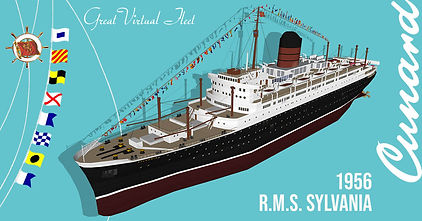
In 1914, after a redesigned, the R.M.S. Aquitania made her maiden voyage, but short after, the First Great War begun. That year Carmania was involved in a fighting with the German Liner S.M.S. Cap Trafalgar, and although Carmania came out wounded, she defeated Cap Trafalgar, but a year later, in 1915, the Lusitania, while carrying passengers, was sunk by the U-Boot 20, of which resulted in 1,960 deaths, 128 were American and this would be an impulse to bring the United States into the war in 1917. After the war, Cunard received the ex-German Liner S.S. Imperator, which became the R.M.S. Berengaria of 1920, but until 1930’s, Cunard focused on build Cabin-Liners instead of giant Ocean Liners. But then, in 1934, after having the Hull 534 in halt, the government forced Cunard to merge with White Star, forming the Cunard-White Star, and in 1936, the famous R.M.S. Queen Mary begun her maiden voyage. In 1938 they received the second R.M.S. Mauretania, and while the R.M.S. Queen Elizabeth was to begun service in 1940, the Second World War begun a year before, in 1939. Both Queens and the Aquitania served splendidly in the war, with the note that the Queen Mary, in 1942, sunk the light cruiser HMS Curacoa while zigzagging to escape the U-Boots, which had a bounty. After the war, both Queens repatriated War Brides to Canada and Queen Elizabeth made her maiden voyage in 1946. In 1947, Cunard received the R.M.S. Caronia, of which was dual purposed, for both normal service and tourism. In 1950, after serving in both World War, Aquitania was finally sold and scrapped, and Cunard-White Star became Cunard Line.
But in 1958, planes became the dominant power, and Cunard started retiring their liners. In 1967, the Queen Mary was sold to Long Beach to become an hotel, which still exist, and in 1968, the same happen to Queen Elizabeth, though she sunk after a fire in 1972 in Hong Kong. In 1969, Cunard received the beloved R.M.S. Queen Elizabeth 2 or simply known as QE2. QE2 sailed with Cunard until 2008, when she was finally retired and now it is an hotel in Dubai.
Cunard still sails to this day, under Carnival rule, with 4 ships: R.M.S. Queen Mary 2 of 2004, the Last Ocean Liner still in service; M.S. Victoria of 2008; the M.S. Queen Elizabeth of 2010 and the M.S. Queen Anne of 2024.
Downloads


.jpg)
.jpg)


.jpg)


.jpg)
.jpg)
.jpg)

.jpg)
.jpg)
.jpg)

.jpg)
.jpg)
.jpg)
.jpg)


.jpg)
.jpg)
.jpg)
.jpg)

.jpg)


.jpg)
.jpg)
.jpg)

.jpg)
.jpg)
.jpg)
.jpg)
.jpg)
.jpg)

.jpg)

.jpg)

.jpg)
.jpg)


.jpg)


.jpg)
